History

The John Adams Institute for Accelerator Science (JAI) was created in October 2004 in response to an initiative by the Particle Physics and Astronomy Research Council (PPARC) and the Council for the Central Laboratory for the Research Councils (CCLRC) to foster accelerator research and development (R&D) in the universities. PPARC and the CCLRC have since merged into the Science and Technology Research Council (STFC).

The JAI was initially a joint venture between the Departments of Physics in the University of Oxford and Royal Holloway University of London, with Imperial College London joining in 2011.

The JAI is physically located in the Denys Wilkinson Building (part of the Physics Department) at Oxford, in the Wilson Building (part of the Physics Department) at Royal Holloway and in the Blackett Laboratory building of Imperial College.

The Cockcroft Institute, a similar joint venture between the Universities of Lancaster, Liverpool and Manchester based at the Daresbury Laboratory in Cheshire, was created at the same time.

These two institutes, together with the STFC Accelerator Science and Technology Centre (also at Daresbury), form the core of accelerator R&D and training in the UK.

The genesis of the UK accelerator centres was an initiative in 1999 to rejuvenate accelerator R&D in the UK. Two programmes formed the core of the original programme of the Institute - one for a future Linear Electron-Positron Collider and the other for a possible Neutrino Factory. Since then, research has expanded considerably, with advanced light sources, plasma-driven accelerators and accelerators for medical applications now among the topics studied. A key strength of the Institute lies in advanced beam instrumentation and diagnostics that enable accelerator techniques and plasma acceleration.

The JAI was proposed initially by Professor Brian Foster (Oxford) and Professor Mike Green (Royal Holloway), with Brian appointed as the interim Director. In 2005, Professor Ken Peach was appointed Director and Professor Grahame Blair was appointed Deputy Director. In August 2010, Professor Andrei Seryi succeeded Ken Peach as Director. After a successful period in charge of the JAI, Professor Seryi was succeeded by the current director, Professor Philip Burrows of Oxford University.


                On the image above - JAI opening in Oxford

Latest news

Hannah Wakeling presenting at IPAC 2025

Hannah Wakeling presents at IPAC2025

Hannah gave an invited talk on environmental sustainability guidelines for accelerators
philip burrows 001 min

Award for Outstanding Research Supervision

Professor Philip Burrows awarded 2024/25 MPLS Awards for Outstanding Research Supervision!
robin timmis

PhD success!

Robin Timmis successfully defends thesis
A photo of the JAI members at JAI Fest 2024 at RHUL

JAI Fest 2024

Our traditional pre-Christmas celebration of the work of our students and postdocs was held on the 19th December
philip burrows 001 min

Philip Burrows at Physics World Live

Panellists discussed how a new collider could shed light on the Higgs boson
philip burrows 001 min

Philip Burrows re-elected Chair of the HL-LHC Collaboration Board

The HL-LHC project aims to increase the performance of the Large Hadron Collider
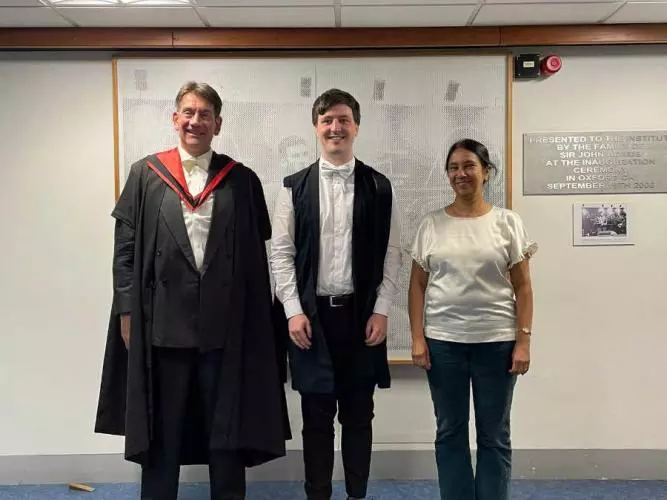
From left to right: external examiner Prof. Steinar Stapnes, Joseph Bateman, supervisor Prof. Manjit Dosanjh, internal examiner Prof. Emmanuel Tsesmelis

PhD Success!

Joseph Bateman successfully defends his thesis
Thomas Fogg proudly pointing to the Denys Wilkinson Building where he completed his award-winning MPhys project on the innovative GaToroid particle therapy system.

Oxford Physics Student Wins Prestigious Gibbs Prize for MPhys Project

Congratulations to Thomas Fogg on this outstanding achievement!
First-year graduate student Corey Lehmann

Corey Lehmann awarded the John Adams Prize

The first-year graduate student worked on Beam Loss Monitors
JAI students visit CERN

JAI student visit and seminar at CERN

The current JAI first-year graduate students have worked on a design project for LhARA.
Cameron Robertson and examiners

PhD Success!

Cameron Robertson successfully defends his thesis
Bethany Spear presenting her poster at IPAC 2024

Members of the JAI present their work at IPAC24

DPhil student Bethany Spear presents her poster
Adrian Oeftiger

Welcome to the JAI!

Adrian Oeftiger to join the John Adams Institute
Pablo Arrutia

PhD Success!

Pablo Arrutia successfully defends his thesis
Collette Pakuza and Carlo Mussolini celebrate defending their theses

PhD Success!

Carlo Mussolini successfully defends his thesis
Collette Pakuza and Carlo Mussolini celebrate defending their theses

PhD Success!

Collette Pakuza successfully defends her thesis
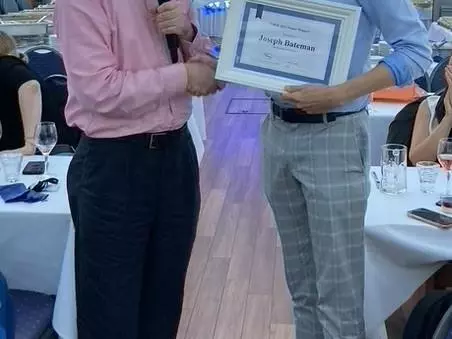
Prof. Roger Jones of Manchester University presents Joe Bateman with the poster prize at the VHEE'2023 conference dinner

JAI student wins poster prize at VHEE'2023

Joe Bateman presented his work on the Fibre Optic FLASH Monitor
Lorenzo Tranchedone pictured at the CLEAR facility at CERN

JAI Summer internship at CERN

Lorenzo Tranchedone
The CLEAR-Robot 2.0

JAI Summer internship at CERN

Ibrahim Najmudin
Jake Flowerdew, holding the previous IBEX Paul trap, stands next to the vacuum vessel containing the IBEX-2 trap in the IBEX lab at the Rutherford Appleton Laboratory.

PhD Success!

Jake Flowerdew successfully defends his thesis
Group photo of the participants at WSFA2023

Advancing Sustainability in Particle Accelerators

With Dr Hannah Wakeling
New doctorate Titus Dascalu

PhD Success!

Titus Dascalu successfully defends his thesis
The John Adams Institute is now on LinkedIn

The John Adams Institute is now on LinkedIn

All Staff, Students and Alumni can now add JAI to the "Experience" section of their LinkedIn Profile
Front cover of the accelerator design report produced by the JAI students

JAI student report published

Report on the FCC-ee positron damping ring and transfer line now available on CDS